Bracket and Unique Mechanism
The freedom-versus-constraint crossing at d ≈ 2.489, the unique-mechanism programme, and the hidden-hypothesis principle.
The Bracket and the Unique Mechanism
A research note from the Determinant Ladder expedition
Status: observation + programme, seeking expert assessment · August 2026
1 · The observation
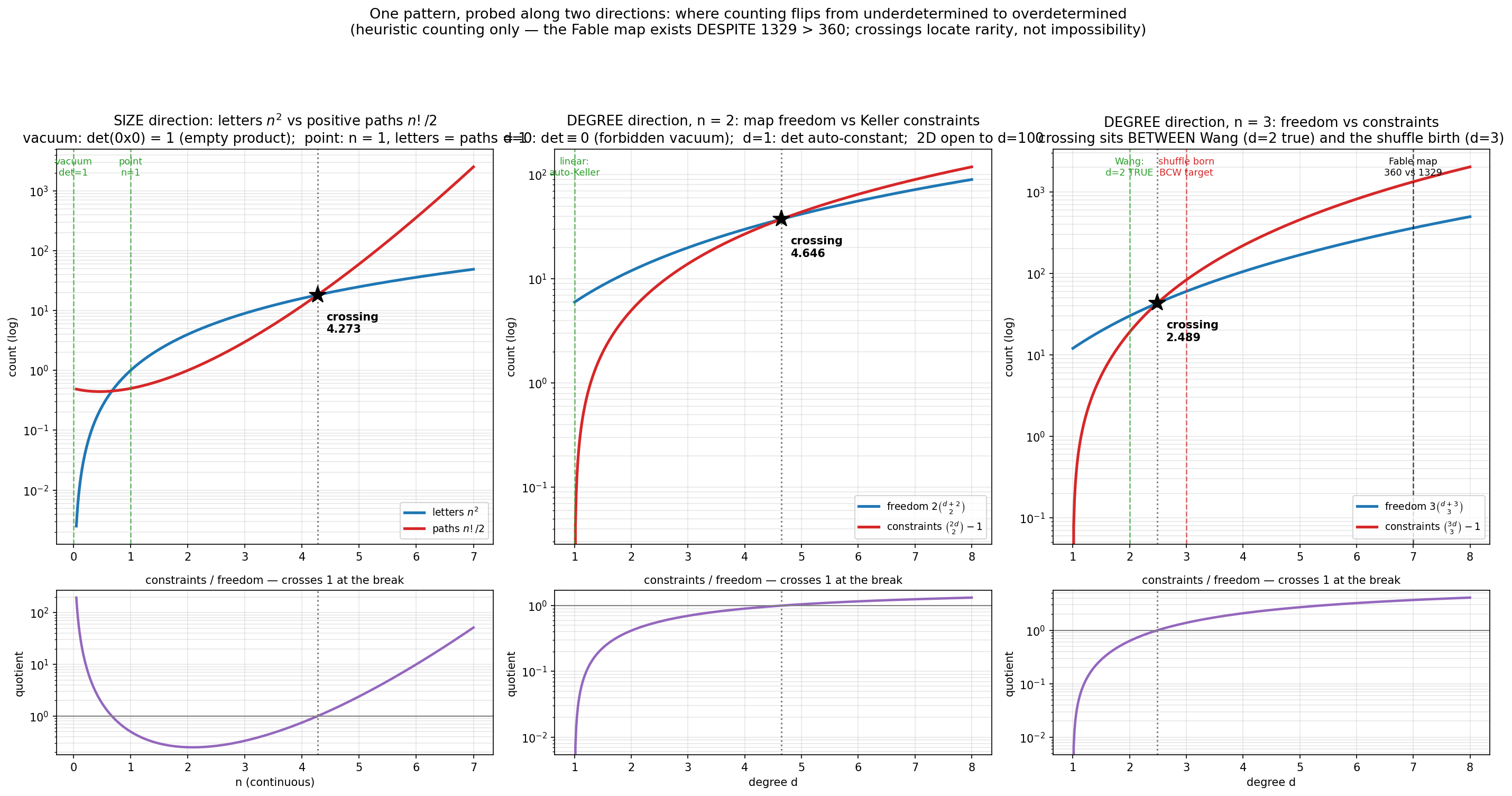
Count what a Keller map has and what it owes. A polynomial map of C^n with all components of degree at most d has n·C(d+n, n) coefficients of freedom. The Keller condition — Jacobian determinant equal to a nonzero constant — demands that every non-constant coefficient of det DF vanish: C(nd, n) − 1 constraints. Extending both counts to continuous d through the Gamma function, the crossing where constraints overtake freedom lands at d = 2 + √7 ≈ 4.6458 for n = 2, and at d ≈ 2.4885 for n = 3. Sanity anchor: at n = 3, d = 7 — the parameters of the 2026 counterexample of Alpöge with Claude Fable 5 — the counts are 360 versus 1,329, precisely the arithmetic quoted in the public dissection of why such maps look miraculous.
The observation this note exists to ask about: the n = 3 crossing at d ≈ 2.4885 sits strictly inside the gap between Wang’s theorem (the Jacobian conjecture holds for maps of degree at most 2, in every dimension) and degree 3, which is simultaneously the birthplace of the factorisation shuffle that powers the known counterexample (a cubic factors as linear times quadratic in three ways; a quadratic splits in only one) and the target of the Bass–Connell–Wright reduction, which concentrates the entire conjecture in cubic maps. Proven-true below the crossing; mechanism-born and reduction-complete just above it; the counting flip in between. Question for those who know the literature: is this bracketing a known observation, a consequence of something standard, or numerology?
2 · Guardrails
Three, stated before anyone can mistake the claim. First, this is genericity counting, nothing more: an overdetermined system can still have solutions, and the counterexample exists at d = 7 despite 1,329 constraints against 360 freedoms — crossings locate rarity, never impossibility. Second, the two crossings near 4 are numerically neighbourly and conceptually unrelated: 4.273 (where n!/2 overtakes n²) measures the drawability of the determinant’s shuffle expansion, while 4.6458 counts polynomial coefficients; the resemblance is coincidence until proven otherwise and should be presented as such. Third, counting knows nothing about mechanisms — it cannot see the shuffle, only the census — so the bracket, even if meaningful, would be a signpost toward structure rather than structure itself.
3 · The unique-mechanism programme
The known counterexample is honestly three-to-one for the oldest reason in algebra: it is secretly the multiplication map (L, Q) ↦ LQ of a linear form and a quadratic form, and a generic cubic admits exactly three factorisations of that shape — the symmetric-group shuffle of three roots, realised on a slice polynomially equivalent to C³. The programme: determine whether this is the only door. Conjecture-shaped statement: every failure of injectivity for a Keller map factors through a multiplication-type mechanism with a nontrivial finite shuffle on fibres. If true it would imply the planar conjecture, because in two variables the analogous product is linear times linear, a factorisation with no shuffle once scalings are normalised — the mechanism is stillborn at n = 2.
The computational evidence gathered so far, with its limits declared: every tame map tested (compositions of shears, invertible by construction) shows zero collisions under numerical hunting; the counterexample and every disguise of it (conjugation by tame maps) collides robustly; and every collider exhibits fibre escape toward infinity, consistent with the theorem that a proper Keller map is a covering of simply connected space and hence a bijection. Two open needs block promotion of this evidence: nobody can currently generate Keller maps outside the tame families and the known counterexample’s orbit — the generation problem is itself open — and the raw escape scale is not conjugation-invariant (compressed from order 10^7 to double digits under disguise), so the programme requires a conjugation-stable measure of the properness defect before any quantitative conjecture can even be stated.
4 · The hidden-hypothesis principle
A lens discovered on the project’s other arrow, offered here because it reframes the whole conjecture. The determinant’s theory silently carries commutativity of multiplication as a standing hypothesis. It is invisible on the lower rungs of the entry-richness ladder — numbers, formal variables, and functions all commute automatically, so the hypothesis is satisfied for free and no one need state it. It becomes binding only when the entries themselves become matrices: block-determinant formulas such as det = det(AD − BC) hold precisely when the blocks are drawn from a commutative subalgebra — for instance the monogenic algebra C[M], all polynomials in one fixed matrix, whose elements always commute — and fail generically otherwise. Meanwhile the determinant’s additive twin walks straight past the cliff: the trace remains additive, and tr(AB) = tr(BA) holds even for non-commuting matrices. The multiplicative invariant carried the hidden hypothesis; the additive one never needed it.
The principle: a hypothesis can be vacuously satisfied at low rungs and binding above, so a theory can appear unconditional for generations simply because nobody had climbed high enough to make its hidden condition bite. And the Jacobian conjecture wears exactly this silhouette on the dimension arrow — stated as a rhyme to investigate, not a theorem. The candidate hidden hypothesis is properness. At n = 1 it is free: a Keller map of one variable is forced linear, hence proper, hence invertible — the hypothesis holds automatically and invisibly. At n = 2 it is conjecturally forced: the open conjecture is exactly the claim that planar Keller maps cannot escape. From n = 3 it is demonstrably independent: the counterexample is a Keller map that is not proper, and non-properness is precisely its escape route, merging points by borrowing room at infinity. On this reading Keller’s conjecture was never “local implies global”; it was “in low dimension, the properness clause of the inversion theorems comes free of charge” — true at rung one, unknown at rung two, false from rung three. The research question the lens generates: find the weakest properness-flavoured condition that low dimensions grant automatically, and prove the plane grants it.
5 · What would count as progress
Three concrete steps, in ascending ambition. Establish whether the d ≈ 2.4885 bracket is known — the appendix drafts the question for MathOverflow. Construct any Keller map of C³ outside the tame group and the known orbit, or prove a structure theorem for why none exists below some complexity threshold; either outcome transforms the unique-mechanism evidence. And define a conjugation-invariant properness defect — a quantity computable from the map, zero on tame maps, bounded away from zero on the counterexample’s whole orbit — in which a sharpened all-dimensions statement could finally be phrased.
Appendix · Draft question for MathOverflow
Title: Does the freedom-versus-constraint count for Keller maps have known significance at the Wang/degree-3 boundary?
Body: A polynomial map of C^n with components of degree ≤ d has n·C(d+n, n) coefficients; the Keller condition det DF = const ≠ 0 imposes C(nd, n) − 1 vanishing constraints. Interpolating through the Gamma function, constraints overtake freedom at d = 2 + √7 ≈ 4.646 for n = 2 and at d ≈ 2.489 for n = 3 — the latter strictly between Wang’s theorem (conjecture true for d ≤ 2, all n) and degree 3, where the factorisation shuffle behind the recent counterexample first exists and where Bass–Connell–Wright concentrate the conjecture. Is this bracketing known, derivable from something standard, or numerology? I am aware the counting is a genericity heuristic only — the 2026 counterexample lives at n = 3, d = 7 despite 1,329 constraints against 360 freedoms, so the crossing locates rarity, not impossibility.