Down the Needle
The fiber of the 2026 counterexample as one geometric object — valleys, mirror, branches, horizons, and the ground floor.
A field appendix to One Formula, Many Worlds: the fiber of the counterexample as one geometric object · August 2026 · third edition
This appendix records two further nights of looking, written as the looking happened: guess, test, correct, keep what survives. Its subject is the picture that closed the main paper — the three colliding points of the 2026 counterexample — examined as a single geometric object. The route collected an exact symmetry, a curve that turned out to be two curves, a hole with drapery around it, an orientation without motion, and the true story of why complex numbers exist. Both participants erred and both were vindicated, and the corrections ran in both directions; that sequence is kept visible on purpose.
1 · What the valleys are
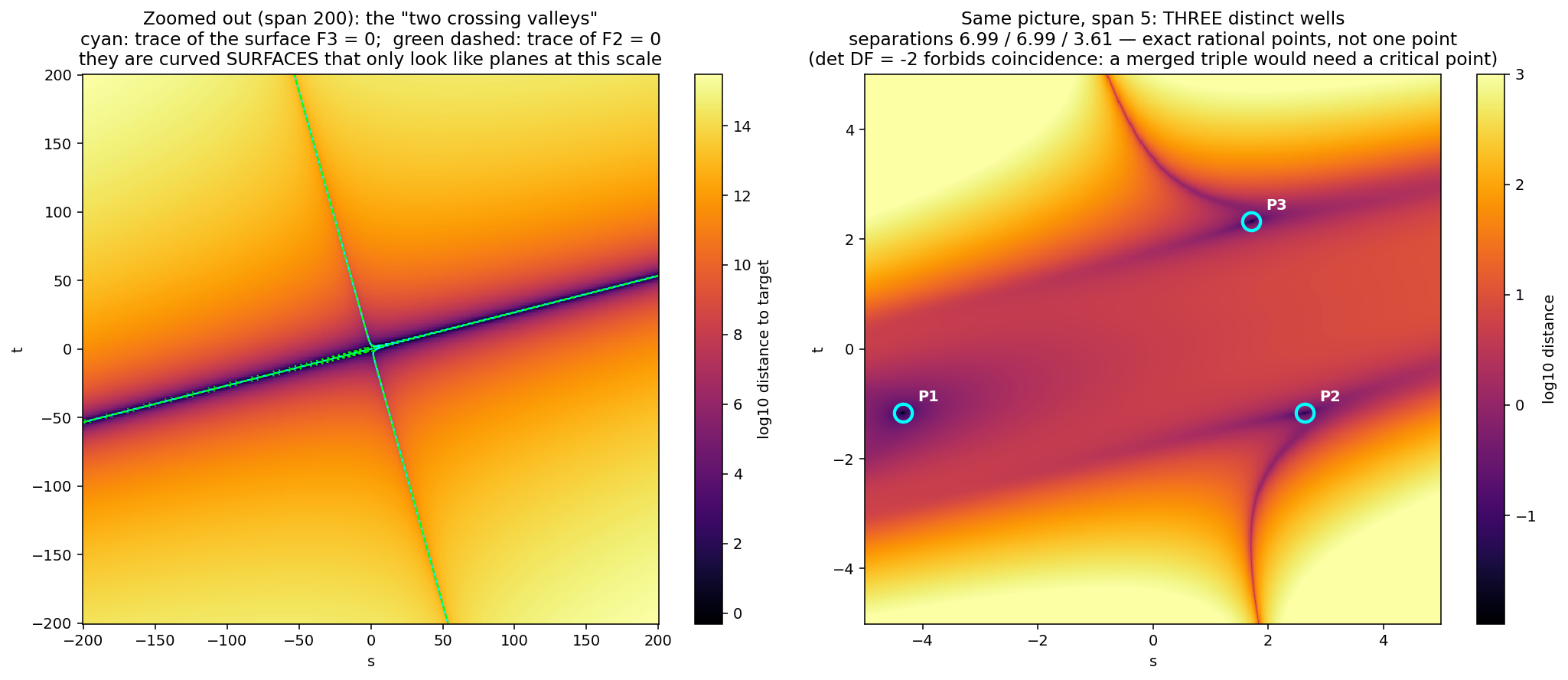
The shared image of the three points is (−1/4, 0, 0) — a target with zeros in its last two slots. Those zeros mean the entire fiber must lie on the intersection of two honest zero-surfaces, {F2 = 0} and {F3 = 0}, and the two great valleys of the zoomed-out heatmap are their traces on the viewing plane: high-degree curved surfaces that impersonate planes at large scale, because far from the origin every polynomial is dominated by its leading terms. A pixel census confirms the identification. The first reading — “two perpendicular zero planes crossing” — was therefore right about zero-sets and right about crossing; planes and perpendicular hold only asymptotically, by the flattery of distance.
2 · The mirror in the fiber
An intuitive reading that the two outer points sit “roughly symmetrically” understated the truth. The involution σ(z1, z2, z3) = (−z1, −z2, z3) fixes F1 and flips the signs of F2 and F3; since the target has zeros in exactly the flipped slots, σ carries the fiber to itself, fixing P1 = (0, 0, −1/4) on the mirror and swapping P2 = (1, −3/2, 13/2) with P3 = (−1, 3/2, 13/2). One mirror-fixed solution and one mirror pair: a transposition inside the S3 root shuffle of the main paper, visible in real space. The symmetry was noticed by eye from a heatmap and confirmed exactly in three lines of computer algebra.
3 · Two components, not one — a correction in the intuition’s favour
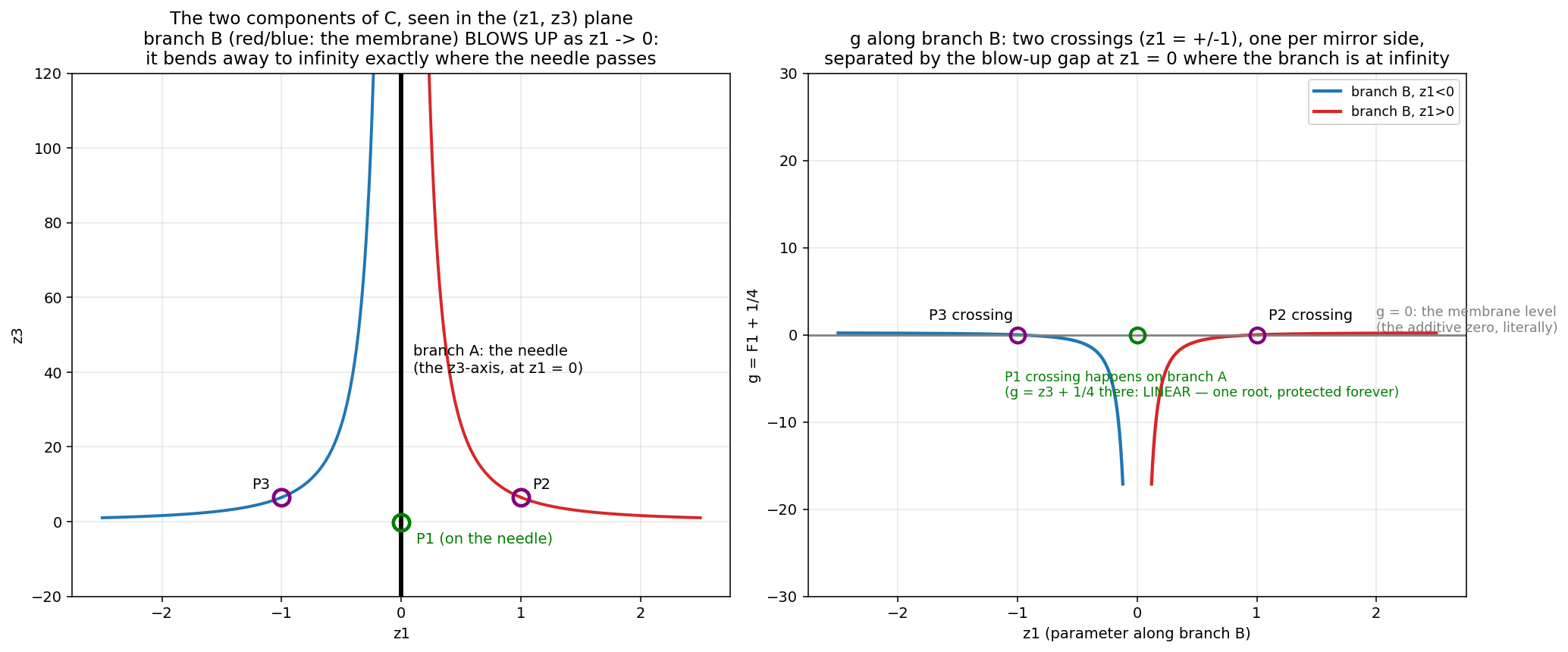
The first formal account of “the three points are one global feature” said: all three lie on the single curve C = {F2 = 0} ∩ {F3 = 0}, along which one function g = F1 + 1/4 crosses zero three times. That account was too flat, and the original intuitive reading it had overruled — a needle-tip point of one character, and a membrane pair of another — turns out to match the actual algebra. F3 factors: F3 = −z1·(z1²z3 + 3z1z2 − 2). The curve C is reducible. Branch A is the z3-axis itself — the needle — and carries P1 alone; on it, g = z3 + 1/4 is linear, with exactly one root, forever. Branch B is a mirror-symmetric curve carrying P2 and P3, with σ exchanging its halves; on it g crosses zero twice, at z1 = +1 and z1 = −1 in the branch’s own coordinate. The three solutions distribute over the components as 1 + 2 — the same split as the degrees in the linear-times-quadratic mechanism of the main paper, now visible as geography. (Further sheets of C exist beyond these two — the intersection curve is high-degree and the numerical probes found additional branches — so A and B are the fiber-bearing components, not an exhaustive inventory.)
4 · The hole and the drapery
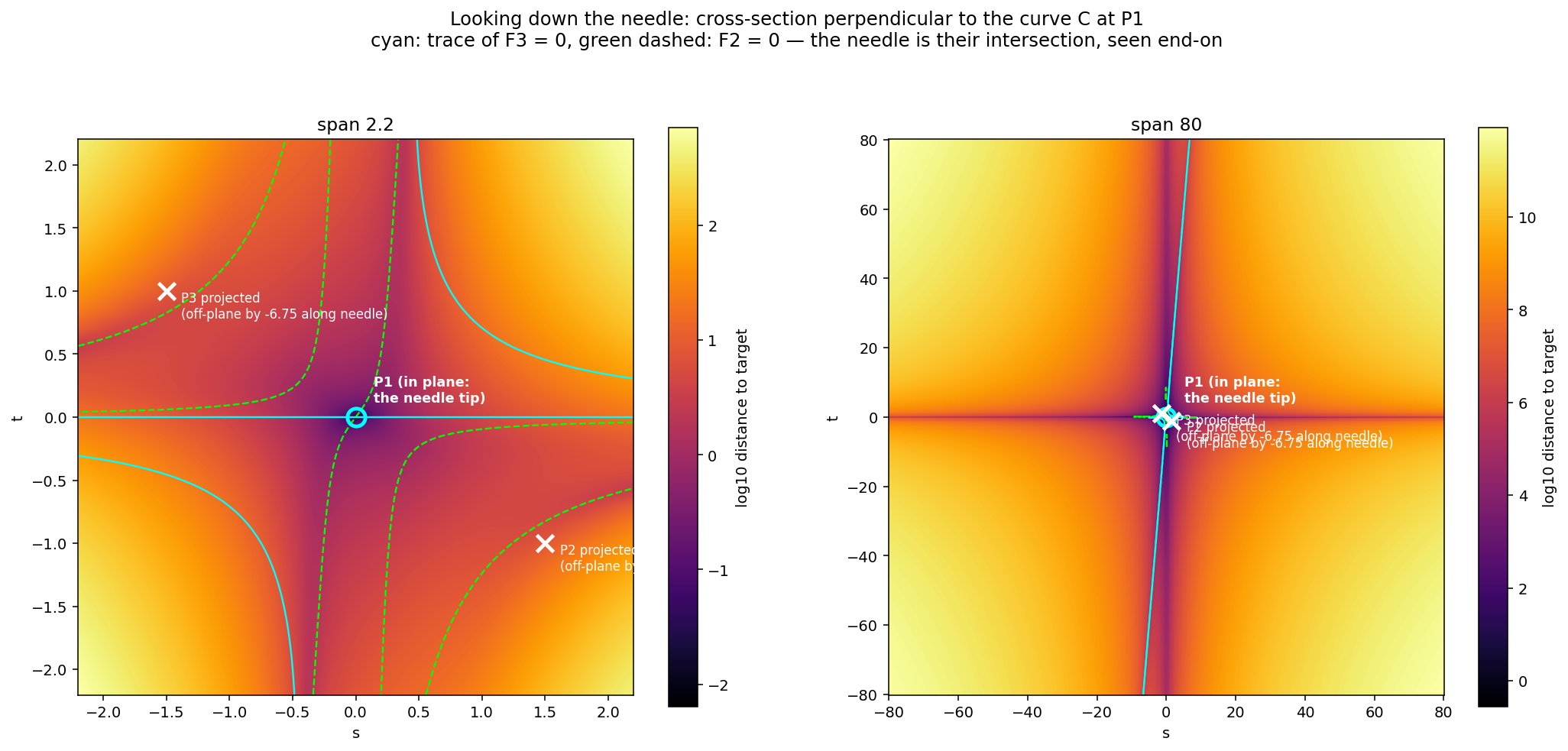
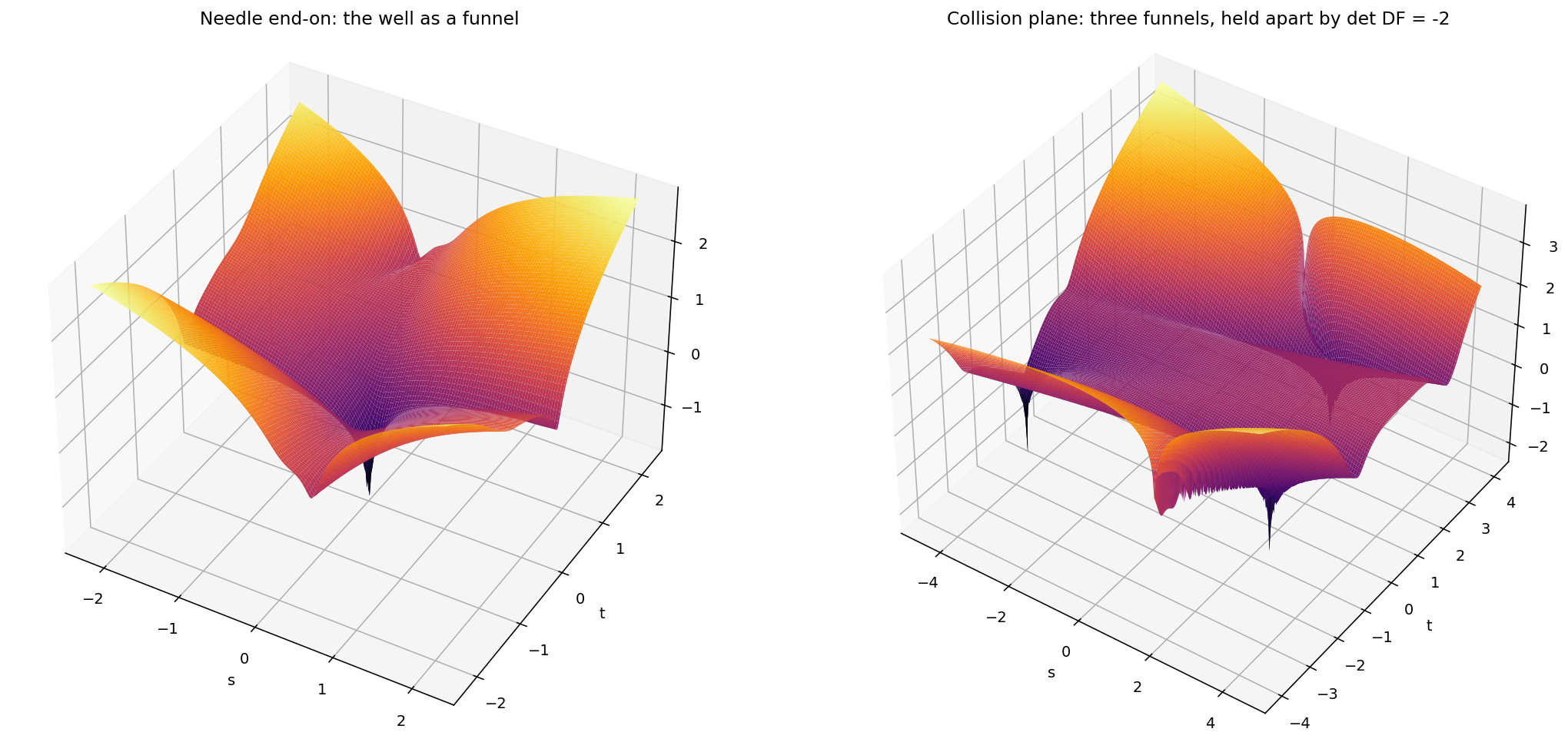
Branch B satisfies z3 = (2 − 3z1z2)/z1², so as z1 → 0 — exactly where the needle stands — the membrane does not meet the needle at all: it bends away to infinity, to z3 ≈ +450 already at z1 = 0.12 and climbing without bound, symmetrically on both sides. The intuitive phrase that prompted this computation was “look at how the membrane layer bends on entry,” and the computation is its precise form: the needle passes through a hole, and the membrane’s edges peel off to infinity around it. This is the non-properness of the counterexample — the escape route to infinity that the main paper measured as fiber escape — here visible as drapery. The cross-section figure shows the same anatomy end-on: the tangent of C at P1 is exactly the z3-axis, the central well sits inside the pinch of the two surface-traces, and the mirror pair P2, P3 occupy a single deeper cross-section, off-plane by identical amounts, antipodal to one another.
5 · Direction without motion
A recurring intuitive vocabulary in this investigation was that of flow — needles entering, wakes, membranes yielding — and the formal reply must be split with care, because half of it fails and half of it names something real. What fails is dynamics: nothing in these pictures moves, there is no time, and any left-versus-right in the first heatmap was an artifact of an arbitrarily oriented slice — flip one basis vector and every bend reverses while nothing mathematical changes. What survives is orientation, which mathematics treats as a static structure in its own right. Three orientations here are intrinsic and coordinate-proof. The membrane level g = 0 has a co-orientation: its two sides are distinguished by the sign of g — and the sign of g is the additive vacuum’s ledger, so the membrane is literally the zero level with a negative side and a positive side. Along the needle, the crossing at P1 passes from the g < 0 side to the g > 0 side: “the needle enters from the negative side” is a theorem-grade sentence. And the drapery hangs one way: branch B’s blow-up is to +∞ on both sides, not −∞. Finally, the habit of reading level-set pictures as flow diagrams has a legitimate formal cousin: the level sets of g together with the direction of its gradient constitute an oriented field — a wind-tunnel diagram’s exact mathematical skeleton — static, arrowed, and real. Direction without motion is not a confusion; entry as a narrative of events is the only part that remains story. One further translation: the “previously invisible space” beyond rupture is not a spatial region hidden behind the membrane — it is the complex continuation, invisible not because it is occluded but because the real slice is an instrument that cannot render it.
6 · Rupture, and where the solutions go
Slide the target and the crossings slide along their branches; at a critical value two of them meet and the discriminant — the classical number built as the product of squared pairwise differences of the roots, the formal measure of the intuition “the spacing of the fabric” — hits zero. The pair does not merge into a fold, which remains forbidden, and does not cease to exist. It leaves: off the real slice and into the complex, as a conjugate pair z and z̄, mirror images across the real axis, for complex conjugation is not like a mirror but is one. The geography of the previous sections says which solutions are which: the pair that can depart together is the σ-swapped mirror pair on branch B, whose two crossings are an even count; the resident of branch A cannot leave at all, protected twice over — by the parity of odd degree, since a mirror-antisymmetric leading term must cross zero somewhere, and by geography, since its branch carries g linearly and a linear function cannot lose its root. Seen from the complex side nothing ruptures — and this is not a modern convenience but the origin story of the complex numbers. Cardano’s 1545 cubic formula forces square roots of negatives precisely when all three solutions are real (the casus irreducibilis, provably undetourable), and Bombelli’s 1572 response was the move these pictures keep suggesting: build the room where the departed solutions live, compute through it, and return carrying real answers. The membrane that tears in the rupture pictures is realness; the fabric underneath was completed once, in 1572, and has never torn since.
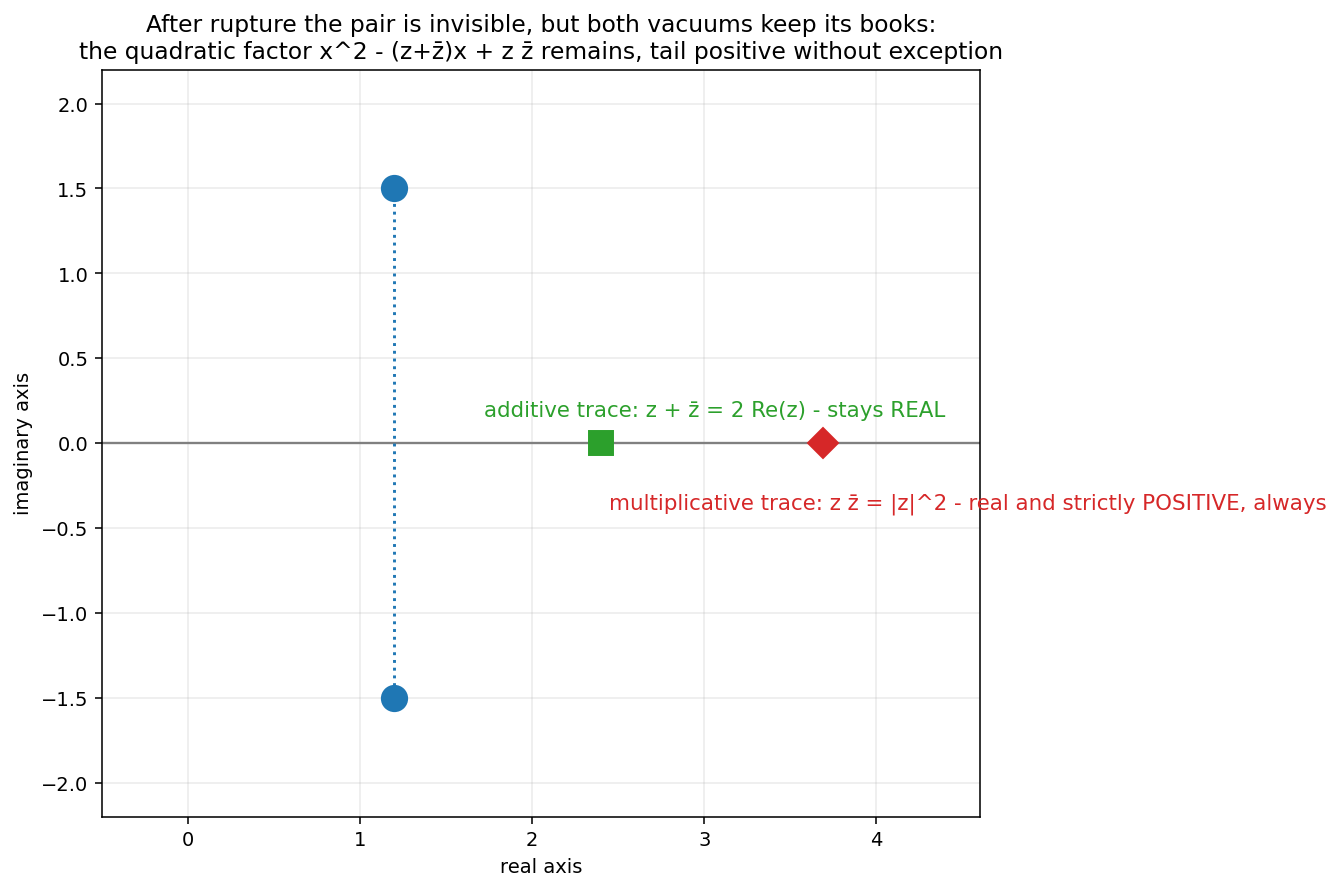
And the departed pair is not gone without record: both vacuums keep its books. The pair’s additive trace — the sum z + z̄ = 2·Re(z) — stays real; its multiplicative trace — the product z·z̄ = |z|² — stays real and strictly positive, forced, without exception. This is why every real polynomial factors over the reals into linear pieces and quadratic pieces with positive-definite tails: each vanished mirror pair persists as a quadratic factor x² − (sum)x + (product), the constant term positively signed forever. After rupture the pair is invisible, but one vacuum keeps its address and the other keeps its light on.
8 · Why it is the multiplicative that pierces
The question sounds like it needs an analogy and turns out to need only a definition. The multiplicative world is constitutionally incapable of containing the additive zero: a multiplicative world worth the name is a group, a group requires every element to be invertible, and zero has no reciprocal. So the multiplicative structure of any number system lives, by definition, on punctured space — the real or complex numbers with the point 0 removed. The hole in the membrane is not an analogy to this fact; it is this fact. The piercing is not an event that happened to the membrane; it is the existence condition of the multiplicative world. And the relationship of the two voids inverts pleasingly at the hole: the missing point is a full citizen of the additive world and a non-member of the multiplicative one — the additive void supplies the address at which the multiplicative world’s absence is located.
Measured in the multiplicative world’s own metric — logarithmically, where the distance from 1 to x is |log x| — the hole is not merely excluded but infinitely far away: a horizon, not a location. This finally explains, with no imagery required, why the needle approaches and never arrives: the exponential bridge marches the entire additive line into the strictly positive numbers and asymptotes toward zero forever, the destination receding at every step in the traveller’s own measure. An earlier intuitive reading — that the needle never truly touches, that there is a contact zone it cannot cross — retires its electromagnetic costume and keeps its content: the non-arrival is exact, and it is metric. Every log-scaled axis this expedition ever drew was quietly saying the same thing, pushing zero off the bottom of the page to minus infinity: the log plot is the multiplicative world’s honest self-portrait, and zero has never once been on the map. Meanwhile the multiplicative nothing itself, 1, sits at log-address 0 — one vacuum living at the other’s coordinates.
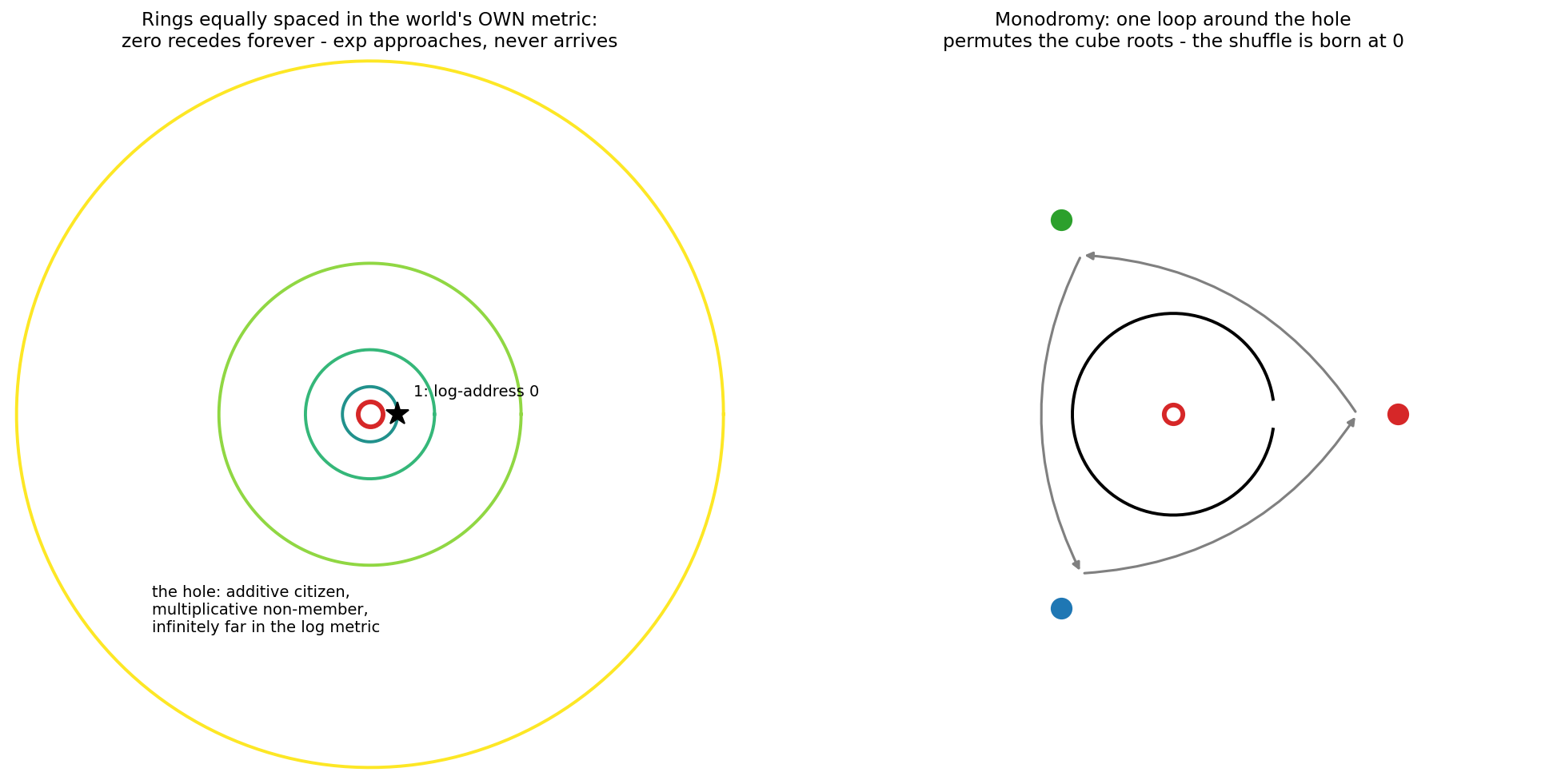
The hole is also where the shuffles are born. Multi-valued roots owe their multiplicity to the puncture: carry a cube root once around 0 and its three values permute — the monodromy of the punctured plane — and every branch cut in the classical function theory is a wound radiating from the additive zero. The S3 root shuffle that powers the counterexample is, at its origin, the ambiguity created by walking around the hole. The needle through the membrane is therefore a portrait of the oldest fact in the two-vacuums story: multiplicativity is additivity with its nothing punched out, and the punching is where the ambiguity comes from.
There is also an operational proof of the puncture, needing nothing but the schoolroom definition. If multiplication is repeated addition, then multiplication at zero is zero repetitions — the empty sum, the operation declining to occur, its “result” merely the sound of nothing happening. Genuine multiplication begins at one copy: 1 is the smallest amount of existence the operation can have, which is why 1, and not 0, is its identity. Multiplication does not exist until you leave zero — and the value it leaves from is 1. The two vacuums thus diverge not somewhere out on the number line but at the concept of “not yet”: at zero repetitions the additive ledger already reads 0 and the multiplicative ledger already reads 1. The hole in the membrane, derived a second way, from nothing but the definition of multiplying.
9 · The two horizons
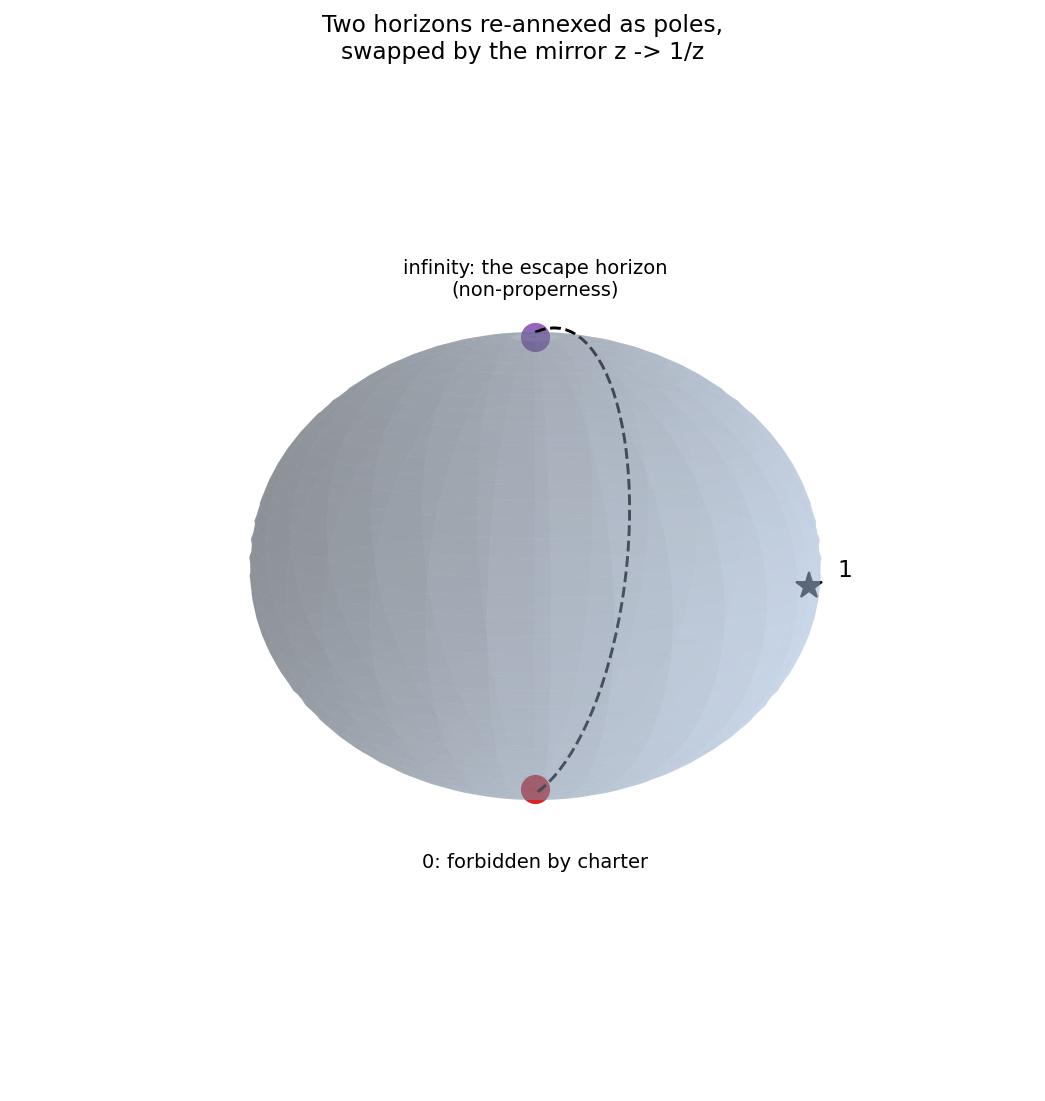
The multiplicative world has not one horizon but two: zero below and infinity above, each at infinite logarithmic distance, and the multiplicative mirror z ↦ 1/z swaps them — zero and infinity are reflections of each other in the multiplicative looking-glass. Mathematics eventually re-annexed both horizons as honest points by wrapping the plane into the Riemann sphere, where 0 and ∞ sit as south and north poles of a single world. And this closes the loop back to the counterexample itself: the escaping fibers, the drapery hitched off the top of every page, the non-properness that constitutes the conjecture’s failure — all of it is activity at the multiplicative world’s other horizon. The map merges its points by routing them toward the twin of the very zero its Jacobian is forbidden to touch. The needle avoids one horizon by charter; the counterexample escapes through the other; between the two infinities, the whole story hangs.
10 · Division by zero, or the ground floor
One last descent, prompted by a question that turned out to be the bottom rung of the entire ladder. “Undefined” was never mathematics saying broken; it is mathematics saying there is no answer within this space — division is a partial operation whose entry ticket simply does not admit a zero divisor, the same quiet legislation met at the matrix-of-matrix fork. And the reason no answer exists inside is the oldest fact in this expedition wearing its smallest costume: multiplication by zero is total collapse, every input crushed to one output, all information destroyed — and division by zero is the demand that the collapse be reversed. The failure even splits by how much was destroyed: for a/0 with a nonzero, no candidate exists at all, the would-be answer receding beyond the boundary to the horizon of section 8 (which the Riemann sphere of section 9 duly annexes, selling a law of arithmetic to buy the point); for 0/0, every number is a candidate at once, a flood in place of a drought. Said in the paper’s own language: multiplication by zero is the 1×1 case of det = 0, and the schoolroom rule against dividing by it is Jacobi’s dependence alarm sounding in its smallest possible instance — no collapse, and inversion is locally guaranteed; collapse, and inversion dies. From the rule every child memorises without reasons to the conjecture that fell in 2026 is one ladder, with no missing rungs.
11 · The ledger of readings
Kept per house rule, now in two columns because the record demands both. Readings first flattened by the formal analysis and later vindicated by better formal analysis: the tip-versus-membrane split (restored as the component decomposition of C, one solution on the needle and two on the membrane); the membrane bending on entry (restored as the blow-up of branch B at the needle); the roughly symmetric pair (restored, upgraded to exactly symmetric); direction (restored as co-orientation and gradient orientation — static, intrinsic, arrowed); and the needle that approaches but never touches (restored, stripped of its electromagnetic costume, as the exact metric fact that zero sits at infinite logarithmic distance — a horizon, not a location). The formal analysis’s own errors, confessed: the premature flattening of all three points onto “one curve” when the curve is reducible and the intuition’s split was the true anatomy; and an initial dismissal of the direction vocabulary before separating its dynamical husk from its orientational core. Readings that did not survive and stay retired: dynamics itself — wakes, eddies, plasma, contact zones — since nothing moves; the primes of the observed coordinates, since √781/4 contains 11 × 71 and no seven, and every such number scrambles under composition with tame maps; and any necessity of degree seven, since degree is not dimension and a degree-3 counterexample exists in higher dimension, with the minimal degree in C³ an open question boxed between 3 and 7. The sorting test throughout was a single question — does it survive a change of coordinates? — and the honest summary of this appendix is that the intuitive readings passed it more often than the first formal replies assumed they would.