Pairing aquifers - leakage as the delivery mechanism
Generated by build_scheme_pairing.py.
Generated by build_scheme_pairing.py.
Every chapter so far has treated leakage as the enemy. That framing is half wrong, and the half it gets wrong may be the more useful half.
The scheme’s environmental objective is to return water to low-level watercourses in summer, and a store already credits 80% of its leakage back to the river as baseflow. So a leaky mound charged in winter is not failing - it is a passive slow-release device delivering exactly the product the scheme was built for, with no pumping cost at all. The only question is whether it releases at the right time.
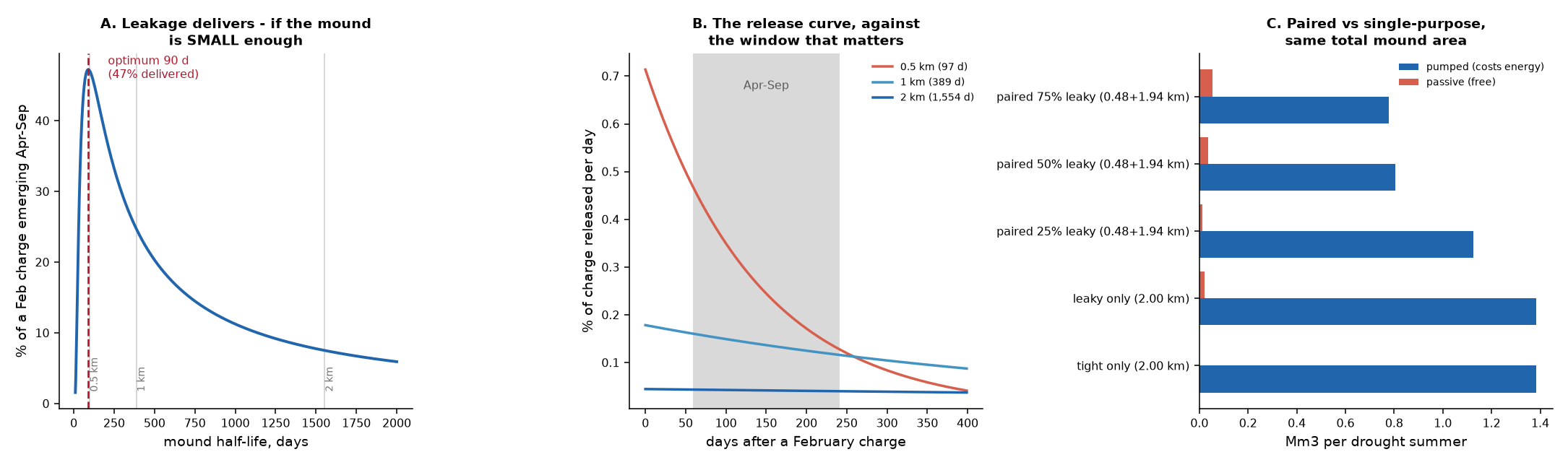
1. There is an optimum, and it is small
A mound charged at t=0 releases at lam*exp(-lam*t), so the fraction emerging in a window [t1, t2] is exp(-lam*t1) - exp(-lam*t2). Maximising for a February charge and an April-September window:
    lam_opt = ln(t2/t1) / (t2 - t1) = ln(4)/180
    half-life = 90 days
    mound radius ~ 481 m
    delivers 47% of the charge into the window
This inverts the design advice of the aquifer chapter. For water you intend to PUMP BACK you want a big mound and a long half-life - the registry’s 1 km store keeps 52% over a year. For water you intend to LET GO into the river you want a small mound and a short one, around 90 days, which is a mound of roughly 0.5 km.
The two objectives want opposite aquifers. That is the argument for pairing them rather than choosing between them, and it is why a single ‘best’ store was never going to serve both halves of the brief.
Panel B shows why the big mounds fail at this job: a 2 km mound releases so slowly that most of a February charge is still underground in September - excellent if you have a pump, useless if you were relying on it to feed the river.
2. Paired against single-purpose, in the model
Total mound area held constant at a 2 km circle and split between a leaky mound (passive, credited to the river) and a tight one (pumped, no river credit):
| configuration | pumped Mm3 | passive Mm3 | total | summer share of passive |
|---|---|---|---|---|
| tight only (2.00 km) | 1.38 | 0.00 | 1.38 | 0% |
| leaky only (2.00 km) | 1.38 | 0.02 | 1.40 | 51% |
| paired 25% leaky (0.48+1.94 km) | 1.12 | 0.01 | 1.14 | 26% |
| paired 50% leaky (0.48+1.94 km) | 0.81 | 0.03 | 0.84 | 27% |
| paired 75% leaky (0.48+1.94 km) | 0.78 | 0.05 | 0.83 | 30% |
The model does not support the idea, and the reason is instructive. Passive delivery never exceeds 0.05 Mm3 per drought summer, against 1.38 Mm3 pumped from a single tight mound, and pairing REDUCES total delivery (0.83 at 75% leaky against 1.38 for tight only).
Why: timing and capacity are the same parameter
The mechanism works exactly as section 1 predicts - the leaky mound does fill in winter and drain through spring and summer. Its mean volume runs 0.58 Mm3 in April, 0.66 in May, 0.11 by September. It is releasing when we want it to.
The problem is how little there is to release, and it is not fixable by tuning:
    half-life  ∝ r^2        (leakage = 2T / (r^2 Sy ln3))
    capacity   ∝ r^2        (volume  = pi r^2 Sy dh)
A short half-life and a large store are the same knob turned opposite ways. The 90-day optimum forces a 481 m mound, and a 481 m mound holds 0.91 Mm3 - about a third of one year’s licensed demand. You cannot have good release timing and a useful volume from the same rock, because both come from r^2.
And it fails worst where it is needed most. In the drought water years the leaky mound holds a mean 0.23 Mm3 through April-September against 0.48 Mm3 in other years - half as much, because a 90-day half-life cannot carry water between years and a drought year has no winter charge to release. It is a within-year device in a between-year problem.
So the answer to “is half our job done?” is no, not for drought - though the idea is not worthless. A leaky mound would raise the environmental baseline in ordinary years at no pumping cost, which is a real if modest benefit, and it is the cheapest thing in the scheme. It simply cannot be the drought mechanism.
The honest caveat on the summer share
The summer share of passive column is the fraction of leakage-to-river arriving April-September. It is nowhere near 100%, because the store is not charged once in February - it is charged whenever the river is high, and it leaks continuously from the moment it holds anything. So the analytic optimum in section 1 is an upper bound on how well the timing can be made to work, not a description of what the model achieves.
What this does not settle
- Where the leakage actually goes. The model credits 80% of it to the river as a flat assumption. Whether it emerges into the reach that needs it, or into a rhyne, or below the tidal limit where it is lost, is a question about gradients and geometry that nothing here answers. That 80% is the softest number in the whole scheme layer and it now carries more weight than ever.
- Whether a leaky mound can be sited at all. A 0.5 km mound with a 90-day half-life is a small target and the compartment has to be in the right place relative to the watercourse being supported.
- Water quality on the passive path. Water leaking to a river has had no treatment beyond settling.
- Real paired compartments. Both mounds here use Sherwood parameters and differ only in radius. The registry has genuinely different rocks - the Chalk holds for decades - and a pairing across formations rather than across radii is the stronger version of this idea.