Fill fast, empty slow - does the concept hold?
Generated by build_operating_concept.py.
Generated by build_operating_concept.py.
A proposal under test, not a recommendation. The idea:
Keep the basin empty and ready. Fill it fast when the river is high - ideally by gravity diversion rather than by pumping. Then empty it into the ground more slowly, but fast enough to be clear before the next event.
Each clause is testable against the structure of divertible events - which nothing in this project had looked at. Earlier chapters swept basin volume and injection rate independently against annual totals, and an annual total cannot see that the resource arrives in a handful of short bursts.
Verdict up front: the event structure supports the concept, and one untested siting question could still kill it.
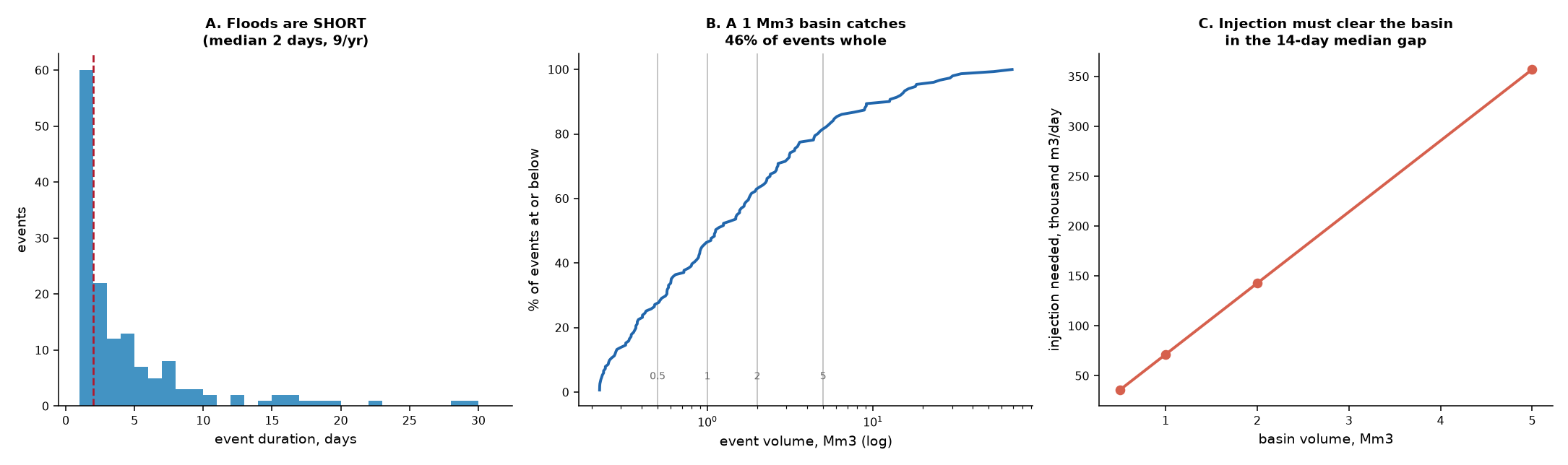
1. The resource arrives in about nine short bursts a year
| system | events/yr | median duration | median volume | mean volume | median gap |
|---|---|---|---|---|---|
| Tone | 9.1 | 2 d | 1.12 Mm3 | 4.28 Mm3 | 14 d |
| Isle+Parrett | 12.5 | 2 d | 1.15 Mm3 | 2.77 Mm3 | 12 d |
| Brue+Yeo | 13.3 | 2 d | 1.64 Mm3 | 4.18 Mm3 | 10 d |
Median event: 2 days, 1.12 Mm3. The mean is 4.28 Mm3 and the longest event in the record ran 64 days, so the distribution is heavily skewed - most events are small and brief, and a few carry most of the water.
2. The events are too fast to pump
To take a median event whole you must move 560,822 m3/day for 2 days. A 150,000 m3/day pump - the size this project has assumed throughout - captures 27% of it.
That is the real explanation of the options finding that the intake pump dominates everything. It was true, and it was a symptom: a pump large enough to matter is a pump trying to swallow a two-day flood through a straw. The right response is not a bigger pump. It is not pumping.
A gravity diversion changes the economics completely. A structure that lets a high river run into an off-line basin under its own head has no capacity limit worth speaking of at these volumes, no energy cost, and no pump to fail on the day it is needed. It also has a hard siting requirement - the basin must sit below the river’s flood level - and the sited candidates in this project do not obviously meet it: S1 carries a 13.3 m static lift. Finding a divertible site is a terrain question the DEM can answer and nobody has asked it.
3. Basin and injection are a matched pair
Two constraints, pulling opposite ways:
- the basin should be large enough to swallow an event whole;
- injection should be fast enough to empty it inside the 14-day median gap before the next one.
| basin | events caught whole | injection needed to clear in 14 d | days to empty at 40k | at 80k |
|---|---|---|---|---|
| 0.5 Mm3 | 27% | 35,714 m3/d | 12 d | 6 d |
| 1 Mm3 | 46% | 71,429 m3/d | 25 d | 12 d |
| 2 Mm3 | 63% | 142,857 m3/d | 50 d | 25 d |
| 5 Mm3 | 81% | 357,143 m3/d | 125 d | 62 d |
The matched pair is a 1-2 Mm3 basin with 71,000-143,000 m3/day of injection. That catches 46-63% of events whole and clears in time for the next one.
Below that pairing the basin spills; above it the wells sit idle waiting for water. Neither number means anything without the other, which is why sweeping them independently against annual totals - as every earlier chapter did - could not find this.
It also reconciles the two settling results. The settling floor is residence x diversion rate and comes out around 0.3 Mm3; the event structure wants 1-2 Mm3. The event structure binds, and by a factor of three to six - so a basin sized for settling alone would be far too small.
What this changes, and what it does not
If it holds, it changes the design target - away from ‘the biggest basin that fits’ or ‘the biggest pump affordable’, and toward a modest basin filled by gravity and emptied by wells on a two-week cycle, roughly nine cycles a winter. The event structure is consistent with that. The siting question below decides whether it is available.
Does not change: the carry-over physics. The mound still leaks at 1/r^2, the store still buys exactly one drought year (drought tests), and demand is still not the constraint.
Not established:
- Whether a gravity-divertible site exists. This is the single most valuable unanswered question in the layer, and it is answerable from the 1 m LiDAR already on disk: find cells below the river’s high-flow level with enough volume above them. Nobody has run that screen.
- Event independence between rivers. The gaps are measured per system; whether the Tone’s quiet fortnight is also the Brue’s is not tested, and it bears directly on the portfolio question.
- Anything about very large events. The longest event ran 64 days and carried 69 Mm3. No basin contemplated here holds a tenth of it, so in those events the scheme takes what it can and the rest passes - which is the correct behaviour for a drought scheme and a poor one for flood attenuation.