Pump sizing - how many units, and where
Generated by build_pump_sizing.py. No model run: arithmetic on the divertible series.
Generated by build_pump_sizing.py. No model run: arithmetic on the divertible series.
Options found the intake pump to be the dominant lever and compared one big intake against three smaller ones, finding concentration marginally ahead. That comparison treated pump capacity as infinitely divisible, and it is not. Pumps and rising mains come in standard sizes, so the real question is how many units and where - which depends on how often a river can actually fill a pump of a given size.
1. There is nothing to pump on 87% of days
Divertible water - flow above the hands-off threshold on days above the trigger - exists on only 13% of days, about 46 days a year, and that is true of all three river systems alike. Any intake is idle most of the year whatever its size, so utilisation is not a reason to build small.
| system | mean flow | mean m3/day | days with divertible water |
|---|---|---|---|
| Tone | 4.96 m3/s | 428k | 46/yr (13%) |
| Isle+Parrett | 2.98 m3/s | 258k | 45/yr (13%) |
| Brue+Yeo | 4.99 m3/s | 432k | 46/yr (13%) |
2. 150,000 m3/day is where the river stops filling the pump
| pump m3/day | Tone captured | Isle+Parrett | Brue+Yeo | days at capacity (Tone) |
|---|---|---|---|---|
| 50,000 | 2.3 | 2.3 | 2.3 | 46/yr |
| 75,000 | 3.4 | 3.4 | 3.4 | 46/yr |
| 100,000 | 4.6 | 4.5 | 4.6 | 46/yr |
| 150,000 | 6.9 | 6.8 | 6.9 | 46/yr |
| 200,000 | 9.2 | 9.1 | 9.1 | 46/yr |
| 300,000 | 13.5 | 13.4 | 13.7 | 40/yr |
| 450,000 | 18.6 | 18.7 | 19.9 | 30/yr |
| 600,000 | 22.5 | 22.6 | 25.0 | 22/yr |
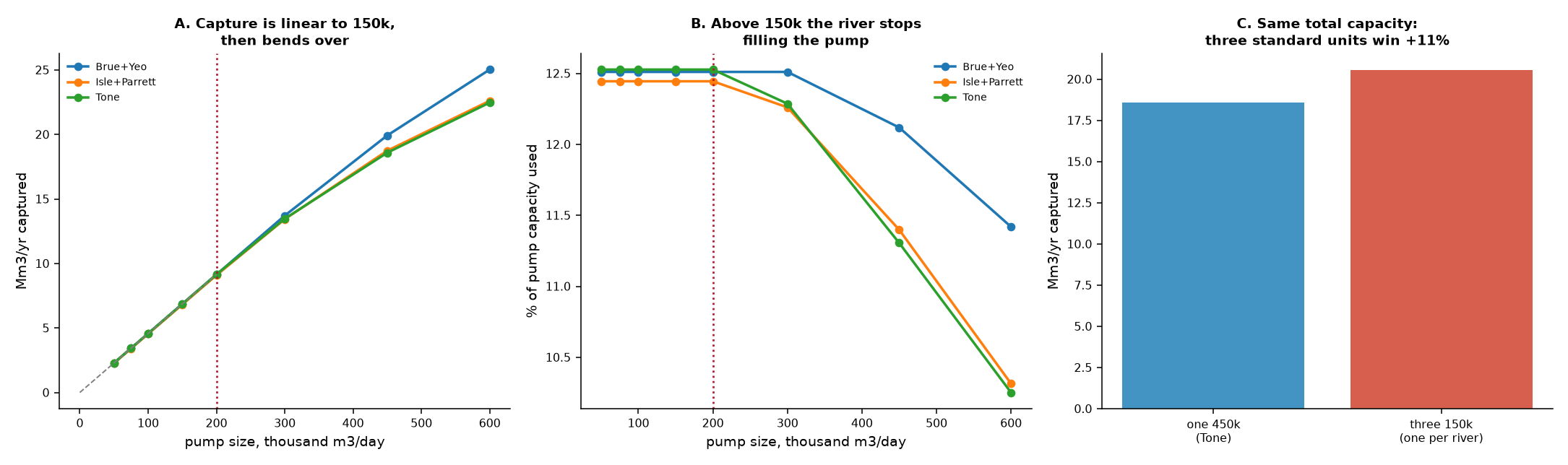
Capture is exactly linear in pump size up to 200,000 m3/day and bends over above it. (Tone 200k, Isle+Parrett 200k, Brue+Yeo 300k - the binding one is the smallest.) Below that ceiling the river fills the pump on every one of its divertible days - doubling the pump doubles the catch. Above it, the days on which the river can fill the pump start falling away, and each extra unit of capacity buys less than the last.
So the hydrology sets a natural unit at about 200,000 m3/day - the largest intake it will keep busy on every day there is water to take. The project’s long-standing 150,000 assumption sits just under it, which means 150,000 is a safe standard size and 200,000 is the most that can be justified per intake without buying idle capacity.
3. Three standard units beat one large one
At the same total installed capacity of 450,000 m3/day:
| configuration | captured Mm3/yr |
|---|---|
| one 450,000 m3/day intake on the Tone | 18.6 |
| three 150,000 m3/day intakes, one per river | 20.5 |
Three standard units capture 11% more water than one large one. The large pump spends its extra capacity waiting for floods big enough to fill it; the three standard pumps are each filled by their own river’s ordinary high flows, and those floods are not simultaneous.
That reverses the reading in options, and the two are not in conflict - they measure different things. Options measured delivery, where the split-mound leakage penalty costs about 5%. This measures capture, where the three-river configuration gains about 11%. The two roughly cancel, and the decision therefore turns on engineering rather than on hydrology:
- standard plant - three off-the-shelf units against one special;
- abstraction spread across three rivers rather than concentrated on one. A 450,000 m3/day intake on the Tone is more than that system’s entire mean flow (428k m3/day), which is a very large ask of one river however the licence is worded;
- redundancy - three intakes do not fail together;
- staging - a portfolio can be built one unit at a time and stopped when it stops paying, which a single large intake cannot.
The recommendation is three 150,000 m3/day intakes on three river systems, accepting a small numerical cost in delivery for standard equipment, spread abstraction, redundancy and incremental build.
What this does not cover
- Costs, again. Three intakes on three rivers need three sites, three sets of consents and more pipeline in total, against one larger structure. Nothing here prices that.
- Whether 150,000 m3/day is a real product size. It is treated as standard because the project has assumed it throughout; a pump supplier would give the actual ladder, and the ladder is what should set the unit.
- Licensing. The Q12.5/Q19 rule is licence-shaped, not a determination. Abstracting a river’s entire mean flow on flood days is exactly the case a regulator would look at hardest.
- Nesting. Isle and Parrett are not fully independent downstream, so the three-river capture total is slightly optimistic.