The design rule, tested
Generated by build_scheme_design.py.
Generated by build_scheme_design.py.
The working hypothesis after options: prioritise the largest flows nearest an available aquifer; build relatively small schemes - smallest reasonable basin, more wells, bigger pumps; and add a settling stage, mainly for timing. Each clause is testable and this chapter tests them.
1. Settling, and the floor it puts under the basin
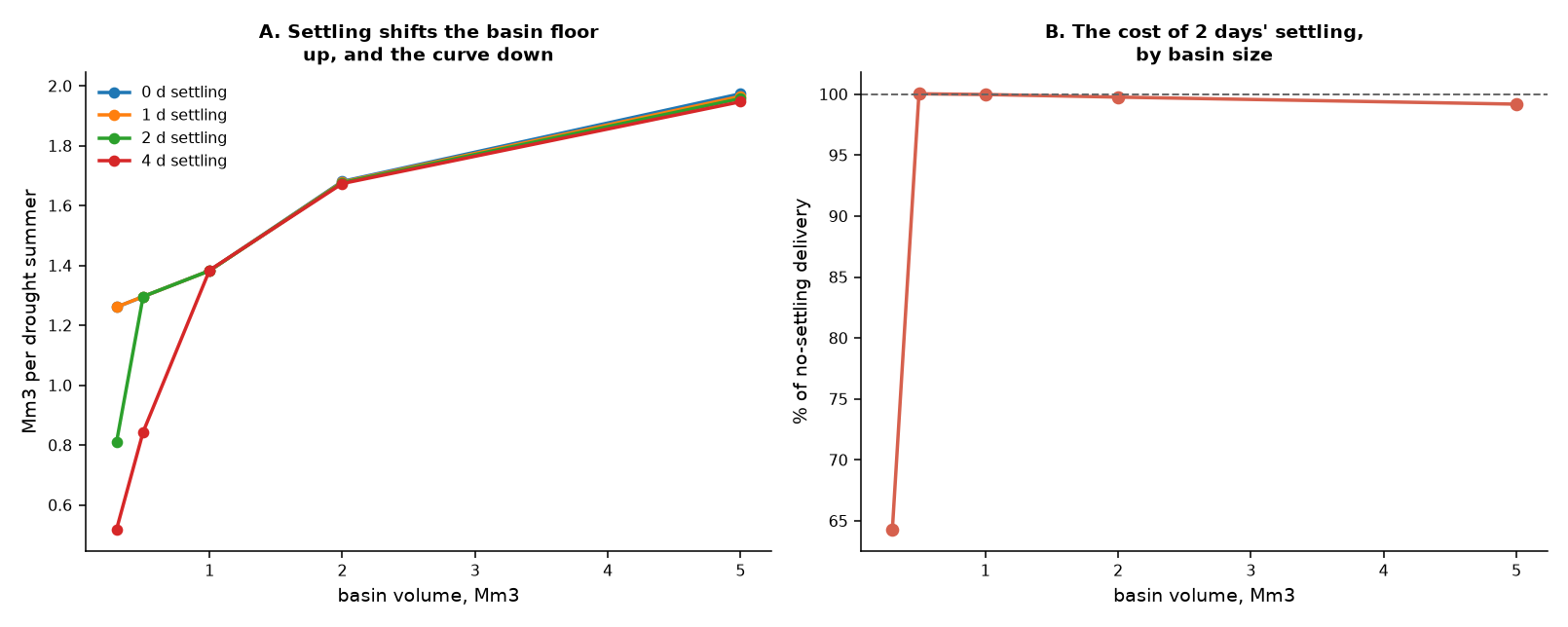
Settling was added to the model for timing: river water diverted today cannot go down a well today, because suspended solids must drop out first or the well clogs. Clogging is the standard failure mode of injection wells and nothing else here represents it. The rule is deliberately crude - whatever arrived within the last residence_days is not injectable, the rest of the cell is.
Its useful consequence is that basin size stops being an arbitrary choice:
    minimum basin ~ residence_days x diversion rate
                  = 2 d x 150,000 m3/d = 0.3 Mm3
0.3 Mm3 - an order of magnitude below the 5 Mm3 the sizing chapter was working with. A basin sized for settling is a very different object from a basin sized for seasonal storage, and the design rule is right that the first is what this scheme needs.
| basin Mm3 | no settling | 1 d | 2 d | 4 d |
|---|---|---|---|---|
| 0.3 | 1.26 | 1.26 | 0.81 | 0.52 |
| 0.5 | 1.30 | 1.30 | 1.30 | 0.84 |
| 1 | 1.38 | 1.38 | 1.38 | 1.38 |
| 2 | 1.68 | 1.68 | 1.68 | 1.67 |
| 5 | 1.97 | 1.97 | 1.96 | 1.95 |
Settling costs little once the basin clears its own floor. At 0.3 Mm3 and above, two days’ residence costs 6% of delivery on average. Below the floor it bites hard, because the basin cannot hold two days of pumping and still have anything settled to inject.
That is the whole argument for a settling stage in one line: it is nearly free if you size the basin for it, and expensive if you do not. It also prices the direct-injection option from options properly - direct injection is settling-free by construction, which is exactly the arrangement most likely to clog.
2. Smallest reasonable basin, more wells, bigger pumps
With two days’ settling, the best basin tested is 5 Mm3 delivering 1.96 Mm3 per drought summer. At the settling floor (0.3 Mm3) it delivers 1.30 Mm3 - 66% of the best, on a basin an order of magnitude smaller.
Combined with the options finding that raising injection from 40,000 to 80,000 m3/day gains 63% on a fixed cell, the design rule holds: the marginal pound goes further on wells and pumps than on earthworks, provided the basin clears its settling floor.
3. Largest flows nearest an available aquifer
Ranking the T3 compartments by divertible resource at the nearest channel, per km of pipe:
| compartment | km2 | pipe km | Mm3/yr at intake | Mm3/yr per km |
|---|---|---|---|---|
| A3 | 16 | 3.5 | 41.8 | 12.1 |
| A14 | 7 | 2.7 | 7.3 | 2.7 |
| A1 | 177 | 5.4 | 12.5 | 2.3 |
| A4 | 2 | 2.4 | 5.5 | 2.3 |
| A2 | 25 | 7.3 | 5.3 | 0.7 |
A3 leads on this rule - 42 Mm3/yr at 3.5 km. It also led on raw resource in availability, so the ranking is not sensitive to whether distance is included.
The options finding then says the portfolio should put its second and third schemes on different rivers, not next to the first - the gain came almost entirely from independent catchments, and splitting a mound on one river actively lost delivery.
What is still missing before this is a proposal
- Costs. Every conclusion here is of the form X buys more than Y, and none of them is priced. Wells against earthworks is the central trade and it is unpriced.
- A real settling calculation. The residence rule is a delay, not a sediment model. It says nothing about the suspended load the Tone actually carries, which sets both the residence time needed and how often the basin must be desilted.
- Well count. ‘More wells’ is modelled as a higher daily injection rate, not as a number of wells with individual yields, spacing and interference.
- Mixed compartments. Every run uses Sherwood parameters. The portfolio argument would be stronger with compartments that behave differently.